

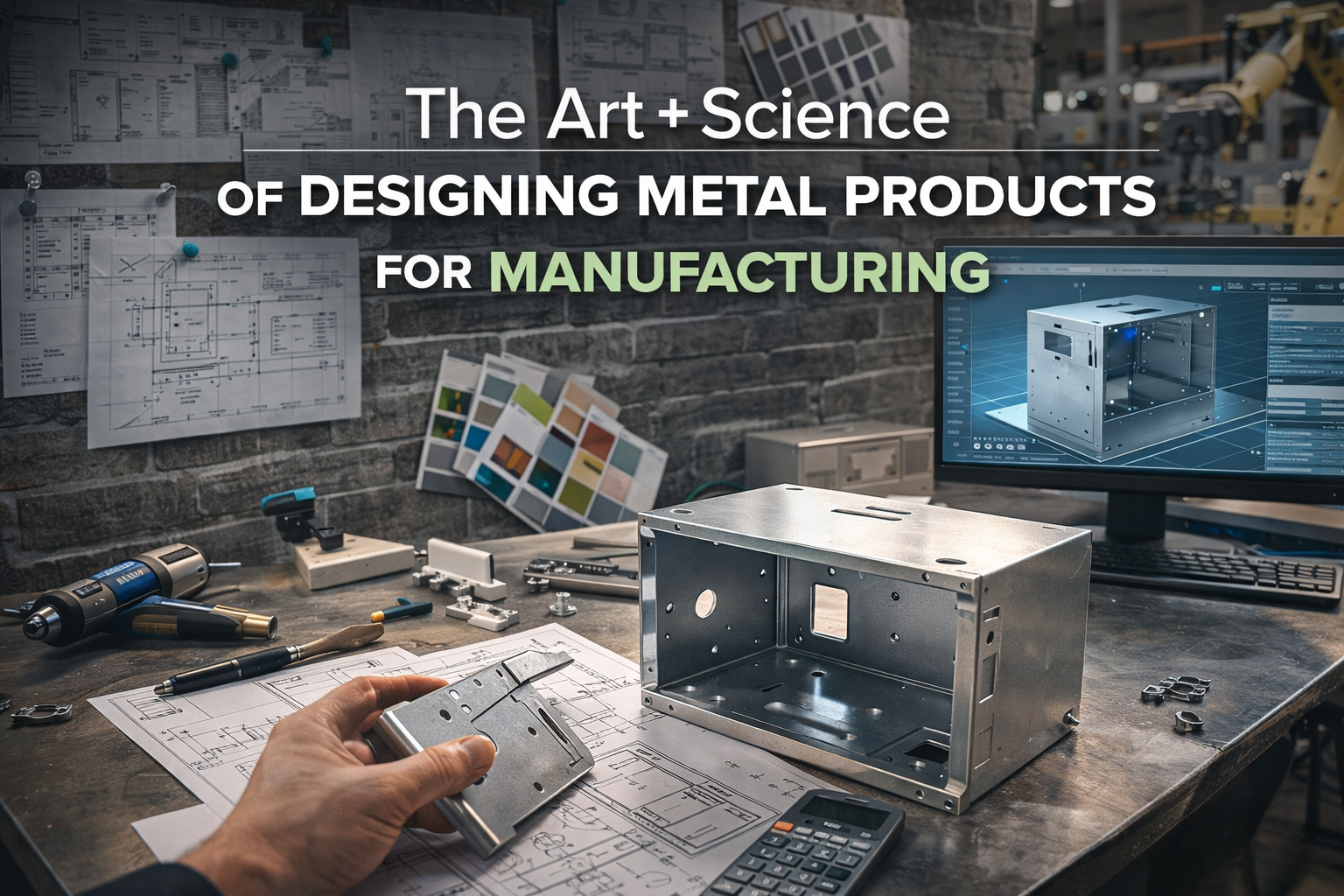
 A product design that looks perfect on screen can become a manufacturing nightmare in the real world. The CAD model renders beautifully, the engineering specs check out, and prototypes work exactly as intended. Then production starts, costs climb, timelines slip, and what should have been a straightforward build turns into months of expensive problem-solving. This disconnect happens more often than most teams expect, and it is rarely because the design itself is flawed. The issue is that great product design and great manufacturing design require different ways of thinking, and when those perspectives do not connect early enough, the gap shows up in very predictable ways—cost overruns, delayed launches, and engineers forced to revisit decisions that were assumed to be final.
At EVS Metal, we see this pattern all the time with precision sheet metal fabrication projects. An RFP comes in after an unexpectedly high quote, or after a first production run exposes problems that never appeared during prototyping. In most cases, the root issue is not engineering capability, but the fact that manufacturing constraints were not part of the design conversation early enough. Most of these problems are exactly what structured design for manufacturability (DFM) is meant to prevent—but when that thinking comes in late, the cost is already locked in. And it usually starts with decisions that seem small at the time.
Where Designs Start to Break Down
One of the first signals is part count. On paper, a design with dozens of individual components can look clean and logical, but in production every additional part introduces friction—more purchasing, more inventory, more handling, and more opportunities for something to go wrong. We have seen enclosure designs built from dozens of separate sheet metal components, each with its own part number and assembly step, where simply stepping back and consolidating those into a smaller number of formed and welded parts dramatically reduced both cost and assembly time without changing how the product functioned. This kind of complexity is rarely intentional. It usually comes from designing components in isolation—optimizing each piece individually without stepping back to simplify the system as a whole. CAD makes it easy to build complexity, but it does not push you to remove it, and once that complexity is in place, it tends to cascade into other decisions.
Sourcing is often where that cascade becomes visible. Designs that rely heavily on custom components—special fasteners, proprietary brackets, or unique hardware—introduce longer lead times, higher costs, and more fragile supply chains. We have worked with products where a single custom component introduced a 10–12 week delay along with significant minimum order requirements, and switching to a standard equivalent eliminated both the delay and the cost without affecting performance. These decisions rarely feel risky in the moment. A designer selects a dimension that does not match standard hardware, or assumes that custom means better. In practice, standard components are usually faster, more cost-effective, and more reliable because they have already been proven at scale.
The same pattern shows up in tolerances. It is easy to apply tight tolerances across an entire design, especially in CAD where precision is essentially free, but in production that precision is anything but free. Tighter tolerances require slower processes, additional inspection, and often secondary machining operations, while also increasing scrap rates when parts fall just outside specification. In most designs, only a handful of features actually require that level of control—typically alignment points or mating surfaces—while everything else can be produced to standard sheet metal tolerances without affecting performance. When precision is applied everywhere, cost increases everywhere.
Material and process decisions add another layer. Choices that seem conservative or “safe” on paper can create real challenges in production, whether that means specifying 316 stainless steel where 304 would perform just as well, designing geometry that is difficult to form consistently, or calling out finishes that introduce additional handling and rework. In many cases, these are not design failures but disconnects between theoretical performance and how parts are actually manufactured. A clearer understanding of material behavior and how parts move through finishing operations would prevent many of these issues before they surface, but when they are overlooked, they compound quickly into cost, time, and variability.
Why Timing Matters More Than Almost Anything Else
Many product development processes still treat design and manufacturing as separate phases. Engineering defines the product, then hands it off to manufacturing to figure out how to build it, but by that point most of the important decisions are already locked. Materials are specified, tolerances are defined, part counts are established, and timelines are committed, which means any change becomes more expensive and more disruptive. This is often where problems first become visible, particularly when moving from prototyping into production, because what worked in early builds begins to break down under real production conditions. That is the point where production strategy starts to matter in ways that were not obvious earlier.
At that stage, teams are left choosing between absorbing higher costs or going back to redesign, and both options are far more expensive than addressing the issue earlier. The pattern is consistent: when manufacturing input comes in late, cost and complexity increase, but when it comes in early, most of these problems never appear in the first place.
Designing with Production in Mind
The goal is not to limit design, but to align design decisions with how products will actually be built. That starts with simplifying wherever possible—reducing part count, using standard components, and applying precision only where it actually matters. It continues with making informed decisions about materials, forming methods, joining approaches like welding, and finishing processes, all of which interact across the full production workflow in ways that are not always obvious during early design.
None of this requires sacrificing performance. In most cases, it improves it, because designs that are easier to manufacture are also more consistent, more repeatable, and easier to scale. What looks like a manufacturing constraint early on is often what makes a product viable at production volumes.
How EVS Metal Approaches This Differently
At EVS Metal, manufacturability is not treated as a final checkpoint. It is part of a broader engineering process that begins early, when design decisions are still flexible. When we are involved at that stage, we help identify where complexity can be reduced, where materials or tolerances can be adjusted, and where production risks may appear before they become real problems. These are often small changes, but they have an outsized impact, because a simplified assembly, a more accessible weld, or a standard material choice can eliminate entire steps before they ever reach production.
Across industries—from medical devices to industrial equipment—the pattern is consistent. The earlier manufacturing insight is part of the conversation, the smoother the transition from design to production.
Start with Manufacturability in Mind
Great product design does not end with a working prototype. It ends with a product that can be manufactured consistently, cost-effectively, and at the scale your business requires. The difference between a smooth production launch and a costly redesign usually comes down to when manufacturability enters the process.
If you are early in development—or already seeing unexpected cost or timeline challenges—EVS Metal can help. We will review your design, identify opportunities to improve manufacturability, and help align performance with production reality. Request a quote to get started.