

Electromechanical assembly is where a lot of manufacturing programs either get simpler or start getting harder than they need to be. When fabricated parts, machined components, wiring, controls, and final integration are split across multiple suppliers, delays and coordination problems tend to multiply fast. Parts move between vendors, fit issues get discovered late, accountability gets blurry, and engineering teams end up spending time managing handoffs instead of moving products forward. That is why electromechanical assembly matters more than it may seem at first glance. It is not just an add-on service. In many cases, it is the difference between a fragmented production process and a coordinated one.
At EVS Metal, electromechanical assembly supports projects ranging from complete enclosure builds for OEM equipment manufacturers to integrated control systems that require electrical components, hardware installation, and final testing. Because assembly teams work directly with fabrication, machining, welding, and finishing, products move through production without the delays that often occur when multiple outside vendors are involved. For manufacturers sourcing complex products, that usually means shorter lead times, fewer coordination problems, and a much clearer line of responsibility when both mechanical and electrical requirements have to come together in one finished assembly.
What Electromechanical Assembly Includes
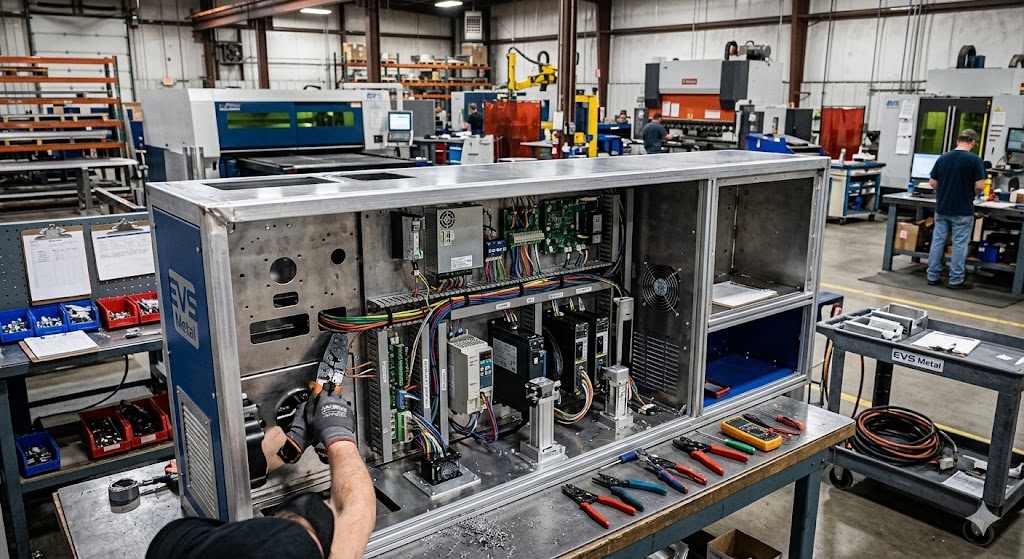
At its core, electromechanical assembly means combining fabricated metal structures with electrical systems to create complete functional products. That includes enclosures, machined brackets, mounting systems, and hardware on the mechanical side, along with wiring, connectors, sensors, controls, power supplies, and circuit boards on the electrical side. Unlike purely mechanical assembly or standalone electrical work, both sides have to align. Mechanical tolerances need to support fit and access, while electrical requirements influence spacing, grounding, and performance. In practice, that often means building products such as industrial control panels, electronics housings, and equipment enclosures where components must be mounted precisely inside fabricated structures.
Why In-House Assembly Changes the Manufacturing Process
When fabrication and assembly happen in the same facility, production tends to move more smoothly because fewer transitions are involved. Fabricated components do not need to be packaged, shipped, received again, inspected by another supplier, and scheduled into a second production queue. That alone saves time, but the bigger advantage is coordination. If an enclosure needs a mounting feature adjusted to improve assembly, that feedback happens immediately when fabrication and assembly teams work side by side. Quality issues are also easier to resolve because fabrication, machining, finishing, and assembly records all live within the same system rather than being split across multiple vendors.
Cost savings are not guaranteed, but they often show up through reduced handling, fewer shipping steps, and simpler supplier management. In many cases, the greater value is not just lower cost, but faster delivery and fewer delays caused by misalignment between vendors.
Core Assembly Capabilities
Hardware Installation and Mechanical Integration
Electromechanical assembly often begins with installing the mechanical hardware that completes a fabricated product. Hinges, latches, threaded inserts, handles, standoffs, and mounting hardware all need to be installed correctly and consistently, and small details make a difference. Torque requirements, installation sequence, thread locking methods, and alignment tolerances all affect how the finished product performs in the field. Some hardware is installed during fabrication, while other components are added later depending on how the product is built, which is why planning assembly early—often through design for manufacturability—has a direct impact on efficiency.
Wire Harness Routing and Electrical Connection
Wiring is one of the areas where electromechanical assembly becomes more specialized. Harnesses need to follow defined paths, maintain bend radius requirements, avoid sharp edges, and remain accessible for service. Routing also affects long-term reliability. Poor wire placement can create wear points, complicate troubleshooting, or interfere with airflow and component access. Electrical terminations must follow specification closely, and grounding becomes critical in assemblies where EMI control or electrical safety requirements apply.
Component Mounting and Integration
Power supplies, relays, terminal blocks, sensors, circuit boards, and control components all need to be mounted in positions that support both performance and serviceability. In many assemblies, placement affects more than convenience. Cooling airflow, wire clearances, maintenance access, and electrical separation all influence how well the final product performs. In more sensitive applications—such as instrumentation, RF systems, or optical equipment—mechanical positioning can directly impact electrical performance.
Testing and Functional Verification
Assembly is not complete when components are installed. Finished products typically go through testing that verifies both mechanical and electrical performance before shipment. That can range from basic continuity checks to full functional simulations under operating conditions. Mechanical verification may include fit and movement checks, while electrical testing often includes power validation and performance verification based on customer requirements. As product complexity increases, testing becomes more structured and more critical to overall quality.
Industries That Depend on Electromechanical Assembly
Electromechanical assembly shows up across a wide range of industries, but the common thread is the need to integrate fabricated structures with electrical functionality in a reliable, repeatable way.
Industrial Equipment and Control Systems
Industrial control systems are one of the most common examples. Fabricated enclosures house PLCs, power distribution, relays, contactors, terminal blocks, and operator interfaces, all of which must meet electrical code requirements while still supporting practical wiring and service access. For example, fabricated electrical enclosures often need to satisfy NEMA or IP ratings while maintaining usable internal layouts.
OEM Equipment Manufacturing
OEM manufacturers often outsource complete subassemblies rather than managing fabrication and assembly separately. A finished unit may include fabricated sheet metal, mounted electronics, internal wiring, and tested operation delivered as a ready-to-integrate product. That approach allows internal teams to focus on design and higher-value production tasks while external partners handle integration.
Electronics and Instrumentation
Electronics housings frequently depend on fabrication features that directly support assembly, including mounting points, access panels, shielding continuity, and thermal management surfaces. In these cases, fabrication decisions immediately affect assembly outcomes. Understanding processes like sheet metal forming often determines whether a design supports clean wiring, reliable mounting, and long-term performance.
Design Decisions That Improve Assembly
Products assemble faster and more reliably when design accounts for assembly from the beginning. Components should be accessible during installation without requiring awkward positioning or partial disassembly. Serviceability matters just as much, since maintenance teams need clear access to replace components later. Mechanical tolerances also play a direct role, because hole alignment, connector fit, and mounting accuracy all influence whether electrical systems install cleanly or require rework. Clear documentation—assembly drawings, wiring diagrams, and bills of material—further improves consistency as production scales.
Quality and Compliance Requirements
Electromechanical assemblies often carry requirements that go beyond general fabrication standards. Electrical safety standards such as UL, CE, NEC, or IEC may apply depending on the application, influencing component selection, spacing, testing procedures, and documentation. A quality framework such as ISO 9001 certification helps ensure those requirements are applied consistently across production.
Some industries add additional layers of complexity. Defense and aerospace programs may require ITAR compliance, while automotive, aerospace, and medical applications often introduce customer-specific documentation, traceability, and testing requirements. In these environments, assembly teams must balance manufacturing efficiency with strict regulatory control.
Integration with Metal Fabrication Operations
Electromechanical assembly works best when it is planned as part of fabrication rather than treated as a separate downstream task. Engineering decisions—such as adding mounting features, installing inserts during fabrication, or designing wire routing paths into sheet metal—can simplify assembly significantly. That coordination is most effective when fabrication engineers, assembly planners, and product designers are aligned early in the process.
Production flow also depends on timing. A typical enclosure may move from cutting through forming, welding, and finishing before assembly begins, so fabrication schedules and component availability need to stay aligned. When planning is coordinated well, production moves without delays caused by missing hardware or incomplete parts.
Assembly also provides feedback that improves fabrication quality. If wiring cannot route cleanly or components do not fit correctly, that information feeds back into fabrication processes, improving consistency in future builds.
EVS Metal Electromechanical Assembly Capabilities
EVS Metal provides electromechanical assembly as part of broader manufacturing programs that include fabrication, machining, welding, and finishing across facilities in Pennsylvania, Texas, New Jersey, and New Hampshire. Programs range from straightforward hardware installation to complex control panel builds with integrated wiring and functional testing. Our engineering teams work directly with customers to improve manufacturability, simplify assembly, and align mechanical and electrical requirements before production begins. Quality systems including ISO 9001 and ITAR registration support projects where documentation, traceability, and compliance are critical alongside fabrication accuracy.
Request a quote or call (973) 839-4432 to discuss electromechanical assembly requirements for your project.