

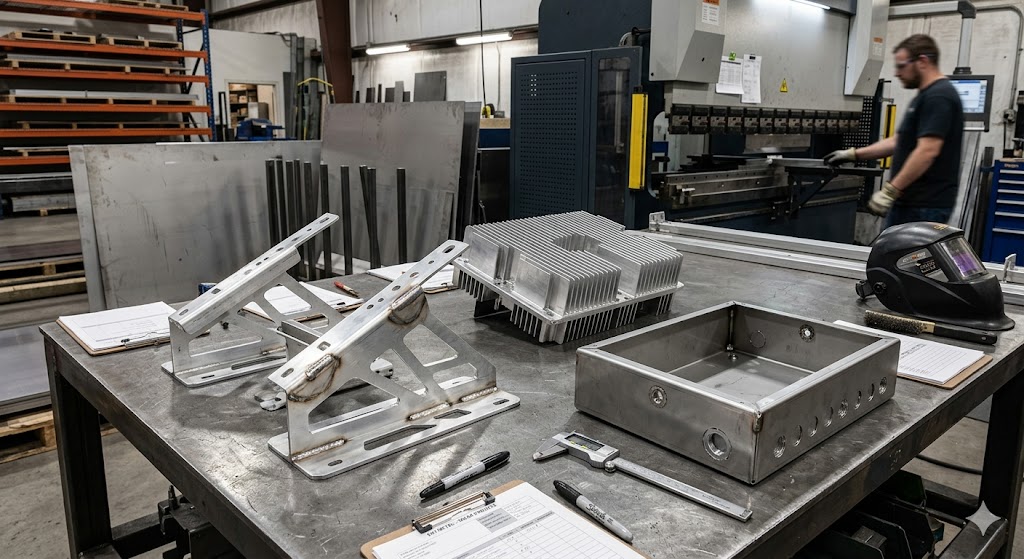
 Solar energy systems depend on precision metal fabrication in ways that often go unnoticed once an installation is complete. Behind every inverter, disconnect, battery system, and mounting assembly are fabricated metal components designed to protect sensitive electronics, support structural loads, and withstand years of environmental exposure without compromising safety, durability, or performance.
Those demands extend well beyond simply cutting and bending sheet metal. Components used in solar applications must tolerate repeated temperature swings, UV exposure, moisture, wind loading, and long operating cycles while maintaining dimensional stability and corrosion resistance over decades of service. A poorly designed enclosure, bracket, or housing may install without issue initially but create thermal, maintenance, or durability problems later in the field.
At EVS Metal, solar fabrication projects often combine laser cutting, precision bending and forming, welding, outdoor-rated finishing, and assembly capabilities to produce complete components ready for installation across utility-scale, commercial, and residential solar systems.
Metal Components Used in Solar Energy Systems
Solar installations rely on fabricated metal parts for both structural support and electrical protection. Some remain visible after installation, while others perform critical functions inside enclosures or beneath panel arrays where long-term reliability matters just as much as initial fit.
Electrical Enclosures and Junction Boxes
Inverters, combiner boxes, disconnects, and monitoring equipment all require enclosures capable of protecting internal electronics from outdoor exposure while still allowing for ventilation, cable entry, and service access. These enclosures often need to meet NEMA requirements while also accounting for the heat generated continuously by power electronics during operation.
That balance between weather protection and thermal performance is where custom fabrication becomes especially important. Vent placement, removable access panels, mounting provisions, and cable routing all influence how well an enclosure performs once installed. In many solar applications, electrical enclosure fabrication must support both code compliance and practical field serviceability rather than simply housing components.
Junction boxes and combiner enclosures also require careful internal layout because wiring density, terminal access, and overcurrent protection affect both installation efficiency and future maintenance. Designs that simplify field wiring while maintaining environmental protection often reduce installation time across large deployments.
Battery and Energy Storage Housings
Battery storage systems introduce another layer of complexity because enclosure design must account for concentrated weight, ventilation requirements, and thermal behavior that varies by battery chemistry. Lithium-based systems, in particular, may require venting provisions, reinforced support structures, and layouts that allow safe maintenance access without compromising environmental protection.
These housings also need to remain practical for technicians servicing equipment in rooftop, utility, or remote outdoor environments where access may be limited and downtime can be costly. Internal layout, removable panels, and service clearances all influence how practical a battery enclosure remains once deployed.
Mounting Brackets and Structural Components
Although major solar array support systems often rely on roll-formed structural members, precision fabrication remains essential for brackets, reinforcement plates, attachment hardware, and specialized mounting details. These components transfer wind, snow, and thermal loads while maintaining alignment across repeated assemblies.
Even relatively simple brackets can create installation delays if tolerances vary across production runs, particularly when hundreds or thousands of identical components are deployed across large projects. Dimensional consistency directly affects field labor efficiency.
Material Selection for Solar Fabrication
Choosing the right material for solar applications means balancing corrosion resistance, structural strength, weight, thermal behavior, and long-term maintenance expectations. In many cases, the operating environment matters just as much as the design of the component itself.
Aluminum for Lightweight Outdoor Performance
Aluminum alloys are widely used in solar fabrication because they combine low weight with strong natural corrosion resistance. That makes aluminum especially useful for rooftop enclosures, heat-dissipating housings, and mounting components where reducing weight improves transportation, handling, and installation efficiency.
Its thermal conductivity also supports applications where heat dissipation matters, although alloy selection and galvanic compatibility remain important whenever aluminum interfaces with other metals outdoors. In rooftop systems especially, lower weight can simplify both structural design and installation logistics.
Stainless Steel for Harsh Environments
Stainless steel fabrications are often selected for installations exposed to coastal salt air, industrial contaminants, or consistently high humidity. In these environments, higher material cost often makes sense because corrosion resistance directly affects long-term reliability and maintenance requirements.
For components expected to remain exposed for decades with limited service access, stainless steel can offer clear lifecycle advantages that outweigh initial material expense.
Carbon Steel with Protective Finishes
Carbon steel remains common in solar fabrication because it offers strength and cost advantages, particularly for larger support components and enclosures where finish systems provide adequate environmental protection.
Its long-term performance depends heavily on coating quality, since protective finishes must continue performing despite UV exposure, thermal cycling, and the possibility of installation damage that exposes bare metal. Where properly finished, carbon steel remains a practical option for many outdoor assemblies.
Design Requirements for Solar Enclosures and Assemblies
Weatherproofing and Environmental Protection
Outdoor solar equipment must resist water intrusion for years under repeated thermal cycling. Gasket materials, mating surface flatness, fastener spacing, and drainage details all influence whether an enclosure continues performing as intended long after installation.
NEMA ratings establish enclosure targets, but design execution determines whether those ratings hold up under actual operating conditions. Small fabrication details often make the difference between nominal compliance and real-world durability.
Thermal Management
Power electronics generate heat continuously, so enclosure design plays a major role in protecting inverter and control system reliability. Ventilation features, screened openings, conductive mounting surfaces, and enclosure geometry all influence thermal behavior.
Applying design for manufacturability principles early helps ensure thermal features remain practical to fabricate without unnecessary secondary operations or excessive cost.
Grounding and Electrical Safety
Metal enclosures must also support reliable grounding paths through doors, removable covers, hinges, and mounting hardware. Bonding points often require special attention when finishes or coatings would otherwise interrupt electrical continuity.
Proper grounding provisions must remain durable throughout years of outdoor service, not simply at installation.
Outdoor Finishing for Long-Term Solar Performance
Powder Coating
Powder coating provides durable corrosion protection and color stability when specified with outdoor-rated formulations designed for UV exposure. Surface preparation and cure quality strongly influence long-term performance.
Lighter finishes may also reduce solar heat gain in enclosures containing temperature-sensitive electronics, which can improve internal operating conditions.
Anodizing
Anodized aluminum creates a durable oxide layer that improves wear resistance and corrosion protection while preserving aluminum’s metallic appearance. It is often selected when long-term appearance matters alongside outdoor durability.
Galvanizing
Hot-dip galvanizing remains a common solution for structural steel components exposed continuously to outdoor conditions where long-term corrosion resistance is critical. It is especially useful for support hardware and larger exposed assemblies.
Why Fabrication Precision Matters During Installation
Fabrication quality directly affects field installation costs. Hole alignment, repeatable dimensions, bracket geometry, and hardware fit all determine how efficiently components install once they arrive on site.
When tolerances drift, installers often compensate through field modification or slower assembly, which quickly increases labor costs across multiple installations. That effect becomes magnified in utility and commercial projects deploying large numbers of identical parts.
Features such as captured hardware, practical access points, and logical assembly sequencing also make maintenance easier once systems are in service.
Solar Fabrication Across Different Project Types
Solar fabrication requirements vary depending on whether components support utility-scale installations, commercial systems, or smaller residential products.
Utility-scale projects usually emphasize repeatability, production efficiency, and durability across large quantities of identical parts. Commercial installations often require more adaptation to architectural conditions, rooftop constraints, and integration with existing building systems, while residential products may place greater emphasis on compact packaging and appearance.
Each application places different demands on enclosure design, finishing choices, material selection, and assembly requirements.
EVS Metal Solar Fabrication Capabilities
EVS Metal supports solar manufacturers, integrators, and OEMs through precision fabrication services including laser cutting, CNC forming, welding, powder coating, machining, and electromechanical assembly across facilities in Pennsylvania, Texas, New Jersey, and New Hampshire.
Our engineering teams support projects from prototype development through production, helping customers refine designs for manufacturability, durability, and repeatable field performance.
Request a quote or call (973) 839-4432 to discuss solar fabrication requirements.
Frequently Asked Questions: Solar Energy Fabrication
What metals are commonly used in solar energy fabrication?
Aluminum, stainless steel, and coated carbon steel are the most common choices depending on corrosion exposure, weight requirements, and structural demands.
Do solar enclosures require thermal design?
Yes. Inverters and electrical controls generate heat that must be managed through ventilation, conductive mounting, or enclosure geometry.
How long should solar metal components last?
Most solar systems are designed around 25–30 year service lives, so fabricated components must maintain corrosion resistance and structural integrity throughout that period.
Can standard electrical enclosures work for solar applications?
Some can, but many systems require custom features for cable routing, mounting, weatherproofing, and thermal management.
What finish is best for outdoor solar equipment?
Powder coating, anodizing, and galvanizing are commonly used depending on material type and environmental exposure.