

 EVS Metal is known for precision metal fabrication, but fabrication alone doesn’t turn a raw component into something that’s ready to ship, install, or put in front of a customer. For many parts, enclosures, and assemblies, the finishing process plays just as important a role as cutting, forming, or welding. It affects how a product looks, how long it lasts, and how well it performs once it’s in the field. One of the most widely used finishing methods for fabricated metal products is powder coating, and for good reason.
Powder coating has become a standard across industrial equipment, electronics enclosures, commercial products, and architectural applications because it solves multiple problems at once. It creates a consistent, professional appearance, but more importantly, it provides a durable layer of protection against corrosion, abrasion, and environmental exposure. At the same time, it fits cleanly into production environments and avoids many of the inefficiencies and environmental concerns tied to traditional liquid paint systems. In a manufacturing setting, that combination matters. A finish has to do more than look good on day one. It has to hold up in use, work within production realities, and support the long-term performance of the product.
What Is Powder Coating?
At its core, powder coating is a dry finishing process. Instead of applying a liquid paint, manufacturers use a finely ground powder made up of resins, pigments, and additives, which is electrostatically charged and sprayed onto a grounded metal surface. Once applied, the coated component is placed into a curing oven, where heat causes the powder to melt, flow, and chemically cross-link into a continuous film.
That final step is what gives powder coating its performance characteristics. Rather than simply drying on the surface like paint, the coating transforms into a solid, bonded layer that is both mechanically and chemically stable. Because of that, the finish is typically more durable, more uniform, and more resistant to wear than traditional liquid coatings. For fabricated metal components, that balance of durability, consistency, and production efficiency is what makes powder coating so practical.
How Does Powder Coating Work?
That process is made possible by electrostatic spray deposition, or ESD, which is the most common application method used in manufacturing. As powder particles pass through a spray gun, they’re given an electrical charge. Because the metal part itself is grounded, those charged particles are naturally attracted to the surface, allowing them to wrap around edges and distribute evenly across complex geometries.
From there, the part moves into a curing oven, where temperatures typically reach between 350 and 400 degrees Fahrenheit. As the powder heats up, it melts and flows, then undergoes a chemical reaction that forms a continuous, cross-linked film. This is the step that turns a loose powder into a durable, finished coating capable of holding up under real-world conditions.
While other application methods exist, ESD remains the standard for most fabricated parts and assemblies because it offers a practical balance of efficiency, coverage, and repeatability in production environments. That repeatability is a big part of why powder coating works so well at scale. When quality has to remain consistent from one run to the next, a stable finishing process matters just as much as the coating itself.
Why Is Powder Coating Used?
 Because of how that coating forms and performs, powder coating is typically selected to address both protection and appearance at the same time. From a performance standpoint, it acts as a barrier between the base metal and the environment, helping to prevent corrosion, resist abrasion, and withstand exposure to chemicals or general wear. That makes it especially valuable for parts used in industrial, commercial, or outdoor settings, where finish failure is more than just a cosmetic problem.
At the same time, the process produces a clean, consistent finish that can be controlled across production runs. It’s available in a wide range of colors, gloss levels, and textures, which allows manufacturers to meet both functional and aesthetic requirements without introducing additional finishing steps. Whether the end product is a piece of industrial equipment, a fabricated metal enclosure, or a customer-facing assembly, that consistency matters.
Because of that combination, powder coating shows up across a wide range of applications, from machine components and architectural metalwork to self-service kiosks and consumer products. It is also widely used in demanding environments like medical device manufacturing, where durability, cleanability, and process control are all critical. In practice, it scales well, performs reliably, and integrates easily into manufacturing workflows, which is why it continues to be a go-to finishing method across industries.
What Are the Main Types of Powder Coating?
When it comes to selecting a powder coating, the conversation is often framed around thermoset and thermoplastic formulations. In practice, though, the more useful distinction is usually the specific chemistry being used and how it performs in the intended environment.
Thermoset powders are the most common in fabricated metal finishing. Once cured, they form a stable, cross-linked structure that does not remelt under normal conditions. Epoxy, polyester, and hybrid systems all fall into this category, and each is selected based on performance requirements. Epoxy powders are typically used for indoor applications where chemical resistance and durability are priorities, while polyester powders are more commonly chosen for outdoor use because they offer better UV stability.
Thermoplastic powders behave differently in that they can soften and remelt when reheated. They’re used in certain specialized applications, but they’re less common in standard sheet metal fabrication compared to thermoset systems.
For most projects, the more relevant question isn’t which category to choose, but which specific formulation best matches the conditions the part will actually face in service. Exposure to sunlight, moisture, chemicals, and mechanical wear all factor into that decision, which is why coating selection is usually tied closely to the overall performance requirements of the finished part.
Why Choose Powder Coating Over Liquid Paint?
That combination of durability and consistency is also what sets powder coating apart from traditional liquid paint systems. Because the coating forms through a heat-driven chemical reaction rather than solvent evaporation, it typically produces a tougher finish with stronger resistance to chipping, scratching, and general wear. It also tends to deliver more consistent coverage across different part geometries, reducing variation from one run to the next.
There are practical advantages on the production side as well. Powder coating eliminates many of the solvent-handling considerations associated with liquid paint, simplifies the finishing process in many cases, and supports repeatable, high-volume manufacturing. In many applications, it can achieve the required performance and appearance in a single step, whereas liquid systems may require multiple coats and additional processing time.
That said, it’s not the right solution for every application. Tight tolerances, heat-sensitive assemblies, or specialized performance requirements may call for alternative finishing methods. But for a wide range of fabricated metal products, powder coating remains one of the most durable and efficient options available, which is why it continues to be preferred in so many production environments.
Why In-House Powder Coating Matters
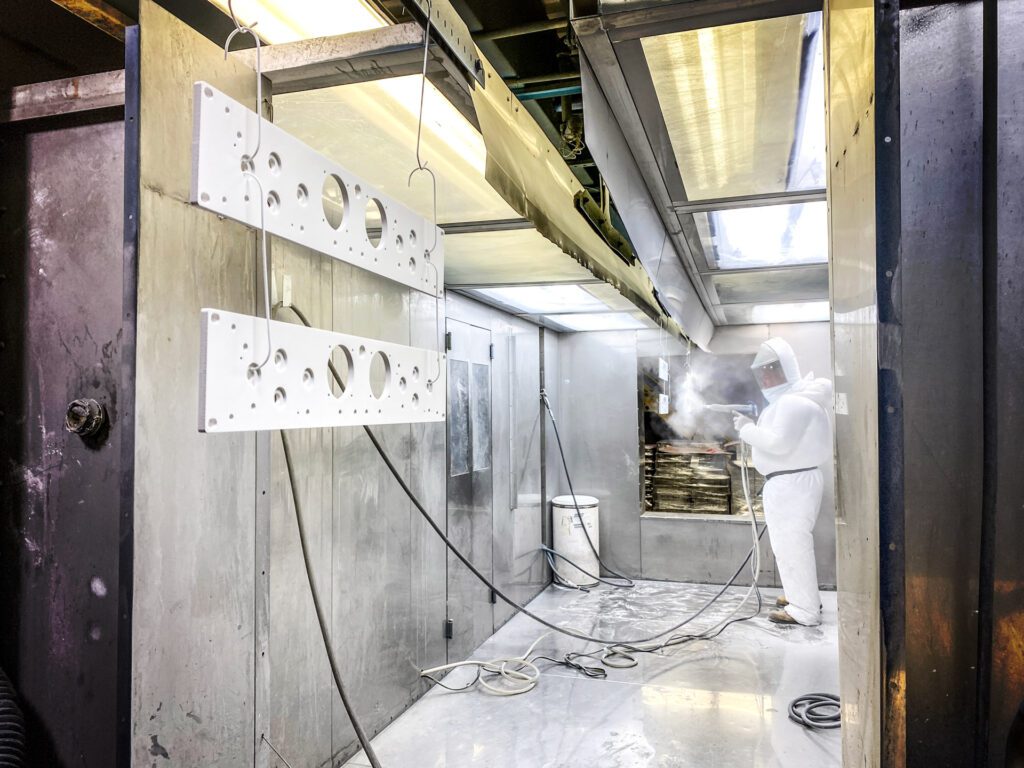 Where powder coating happens can be just as important as how it’s applied. When finishing is outsourced, it introduces additional steps into the process — transportation, scheduling, and coordination between multiple vendors — all of which can affect lead times and quality control.
At EVS Metal, powder coating is part of an integrated manufacturing approach. Fabrication, machining, welding, assembly, and finishing are coordinated within the same operation, allowing for tighter control over both timeline and process quality. It also creates a clearer line of accountability, since the same team is responsible for the product from raw material through final finish.
For customers, that typically translates into more predictable delivery, fewer handoff issues, and a more streamlined production process overall. It’s also why many manufacturers specifically look for in-house powder coating capabilities when evaluating fabrication partners. The finish may be one step in the process, but it can still affect schedule, quality, and customer perception in a very visible way.
Powder Coating at EVS Metal
EVS Metal provides precision fabrication, CNC machining, and metal finishing services for projects ranging from prototypes to high-volume production. Our in-house powder coating lines support customers across New Jersey, Pennsylvania, Texas, and New Hampshire, helping reduce lead times and maintain consistency across projects of varying scale.
If your project requires durable, professional finishing on fabricated metal components, request a quote online or call (973) 839-4432 to discuss your requirements with the EVS Metal team.
Frequently Asked Questions
What is powder coating used for?
Powder coating is used to protect and finish fabricated metal parts, enclosures, assemblies, and products by improving corrosion resistance, durability, and overall appearance.
How is powder coating different from paint?
Powder coating is applied as a dry powder and cured with heat, forming a more durable, uniform finish than traditional liquid paint, which relies on solvents and air drying.
Is powder coating only decorative?
No. While it improves appearance, powder coating is primarily used to protect the underlying metal from corrosion, wear, and environmental exposure.
What metals can be powder coated?
Steel, stainless steel, and aluminum are most commonly powder coated, along with other metals that can withstand curing temperatures and support electrostatic application.
Why do manufacturers prefer powder coating?
Manufacturers often choose powder coating because it delivers a durable, consistent finish while supporting efficient, repeatable production processes.